Voiding DysfunctionHigh-yieldUpdated Sept 202621 min read
Male Stress Urinary Incontinence
On this page
- In an elderly incontinent man with unremarkable examination and labs, the next step is post-void residual measurement (EAU strong), mainly to detect chronic retention with overflow from outlet obstruction.
- EAU advises against antimuscarinics and combination therapy in men with a PVR above 150 mL, and a high PVR is what triggers invasive urodynamics or renal ultrasound.
- Post-prostatectomy stress incontinence persisting despite self-directed Kegel exercises is next treated with pelvic floor muscle therapy (PFMT) led by a pelvic floor physical therapist, usually before surgery is considered.
- Post-prostatectomy continence keeps improving for 6–12 months, so wait that long before a male sling or AUS; severe SUI failing PFMT may be considered for surgery from 6 months.
- Delay surgery for post-prostatectomy stress incontinence for at least 6–12 months, managing with pelvic floor muscle training and containment, because continence can keep improving for up to 2 years.
- If post-prostatectomy incontinence remains bothersome after the 6–12 month wait, exclude urethral or anastomotic stricture and bladder dysfunction before any anti-incontinence surgery.
Definition & Causes
- Most common cause of male SUI = ISD, from:
- Radical prostatectomy — most common single cause
- BPH procedure (TURP)
- Pelvic fracture (urethral injury)
- SUI develops only with concomitant internal AND external sphincter impairment — one alone does not cause SUI
- Internal sphincter impairment (4):
- Pelvic surgery
- Bladder neck injury
- Specific sympathetic neuropathic dysfunction
- Embryologic disruption
- External sphincter impairment (5):
- RP (most common)
- TURP
- Pelvic fracture urethral injury
- Myelopathy (traumatic/acquired)
- Congenital (spinal dysraphism, sacral agenesis, exstrophy/epispadias)
- Internal sphincter impairment (4):
- IPT = incontinence after prostate treatment — the AUA's preferred term over "post-prostatectomy incontinence", because it also covers RT and BPH surgery
- Mechanism: damage to the striated muscle and nerve fibers of the voluntary (striated) urethral sphincter
Natural History & Pre-Treatment Counseling
- Continence = pad-free (no pad or protective device) — the accepted guideline definition
- Most men are NOT continent at catheter removal — counsel that continence is not immediate
- 90% continent at 6 months post-RALP; only a further 4% gain continence after that
- Maximum improvement by 12 months, minimal-to-no improvement afterwards
- Exam answer: continence can keep improving for up to 2 years after RP → another reason to delay surgery
- Risk factors for IPT after RP (5):
- older age
- Larger prostate size
- Shorter membranous urethral length
- Lack of bilateral NVB preservation
- Bilateral NVB preservation → 26% more likely continent at 6 months; no other surgical maneuver improves continence recovery
- Prior pelvic radiation
- Open RP = robot-assisted RP for incontinence rates
- Prior radiation → counsel that they may require an AUS
Evaluation of Incontinence After Prostate Treatment
- Hx + PE + QoL + Pad weight
- Categorize: SUI or UUI
- UUI → manage as OAB
| Recommended | Optional |
|---|---|
| History + physical (incl. degree of bother) | PVR |
| Urinalysis ± culture | |
| Modalities to categorize type + severity (voiding diary, pad weights) |
- History pointers:
- Straining/walking/cough/exercise → SUI
- Sudden compelling desire → UUI
- Leakage while asleep + nocturia → UUI or severe SUI
- PVR — rules out overflow; elevated PVR may signal detrusor underactivity or obstruction
- Exam answer: EAU makes PVR part of the basic assessment (strong) → elderly incontinent man with unremarkable exam + labs → next step = PVR
- Mainly to detect chronic retention with overflow from outlet obstruction
- PVR > 150 mL → EAU advises against antimuscarinics and combination therapy
- High PVR → triggers invasive urodynamics or renal ultrasound
- Exam answer: EAU makes PVR part of the basic assessment (strong) → elderly incontinent man with unremarkable exam + labs → next step = PVR
- Rule out a urethral stricture before attributing leakage to sphincteric incompetence
"Complicated" incontinence — refer for further assessment rather than treating empirically:
- Recurrent or total incontinence
- Incontinence associated with pain, hematuria, recurrent infection, prostate irradiation, or radical pelvic surgery
- Any other abnormality detected, e.g. a significant post-void residual
Severity by 24-h pad weight
| Severity | 24-h pad weight |
|---|---|
| Mild | < 150 g |
| Moderate | 150–400 g |
| Severe | > 400 g |
Conservative Management — always first
- Always start with pelvic floor muscle therapy
- Should be offered to all patients
- Improves time to continence (so QoL) but not overall continence at 12 months
- offer PFMT ± biofeedback ± electrostimulation to men undergoing RP to speed recovery of UI
- PFME vs PFMT — PFME is self-guided, PFMT is practitioner-guided
- Post-RP SUI persisting despite self-directed Kegels (PFME) → next step = PFMT led by a pelvic floor physical therapist — still helps after Kegels, usually tried before surgery
Timing of Surgery
- If SUI → management should be offered 6–12 months after
- Continence keeps improving for 6–12 months after RP → wait at least that long before a male sling or AUS; manage meanwhile with PFMT + containment
| Timing | Condition |
|---|---|
| 12 months | Default. Offer treatment for persistent bothersome SUI at 12 months |
| 6 months | Early intervention — no improvement at 6 months despite conservative therapy + bothersome IPT + patient doesn't want to wait. Most severe SUI shows no significant improvement after 6 months |
| Delay/caution | Patient still showing improvement at 12 months → offer treatment with caution |
- Treat symptomatic vesicourethral anastomotic stenosis or bladder neck contracture before any incontinence surgery.
- After radical prostatectomy, wait at least 6 months so a contracture can declare itself.
Pre-Surgical Assessment
If no improvement & planning for surgical intervention, assess the following:
- Leakage still bothersome after the 6–12 month wait → exclude urethral / anastomotic stricture and bladder dysfunction before any anti-incontinence surgery
Pad weight — mild < 150 g · moderate 150–400 g · severe > 400 g
- → drives the choice of operation (see Management by Severity).
Hx of radiation — if yes, slings are contraindicated
UA + PVR + Ufm — UDS is optional if suspicion
- The catheter false-negative — high yield. Up to 35% of men with post-prostatectomy SUI will not demonstrate SUI with a catheter in place (scarring at the anastomosis; even a small catheter occludes the urethra). → Remove the catheter and repeat stress testing
- UDS findings that change the operation
- Detrusor hypocontractility → AUS, not sling — inadequate detrusor function cannot overcome the fixed resistance of a compressive sling
- Reduced compliance — prolonged high-pressure storage risks renal deterioration
- AUA 2012 UDS guideline: at minimum, assess PVR before invasive SUI therapy
Cystourethroscopy — if patient has bladder neck contracture, incise & delay AUS implant 3 months
Management by Severity — the algorithm
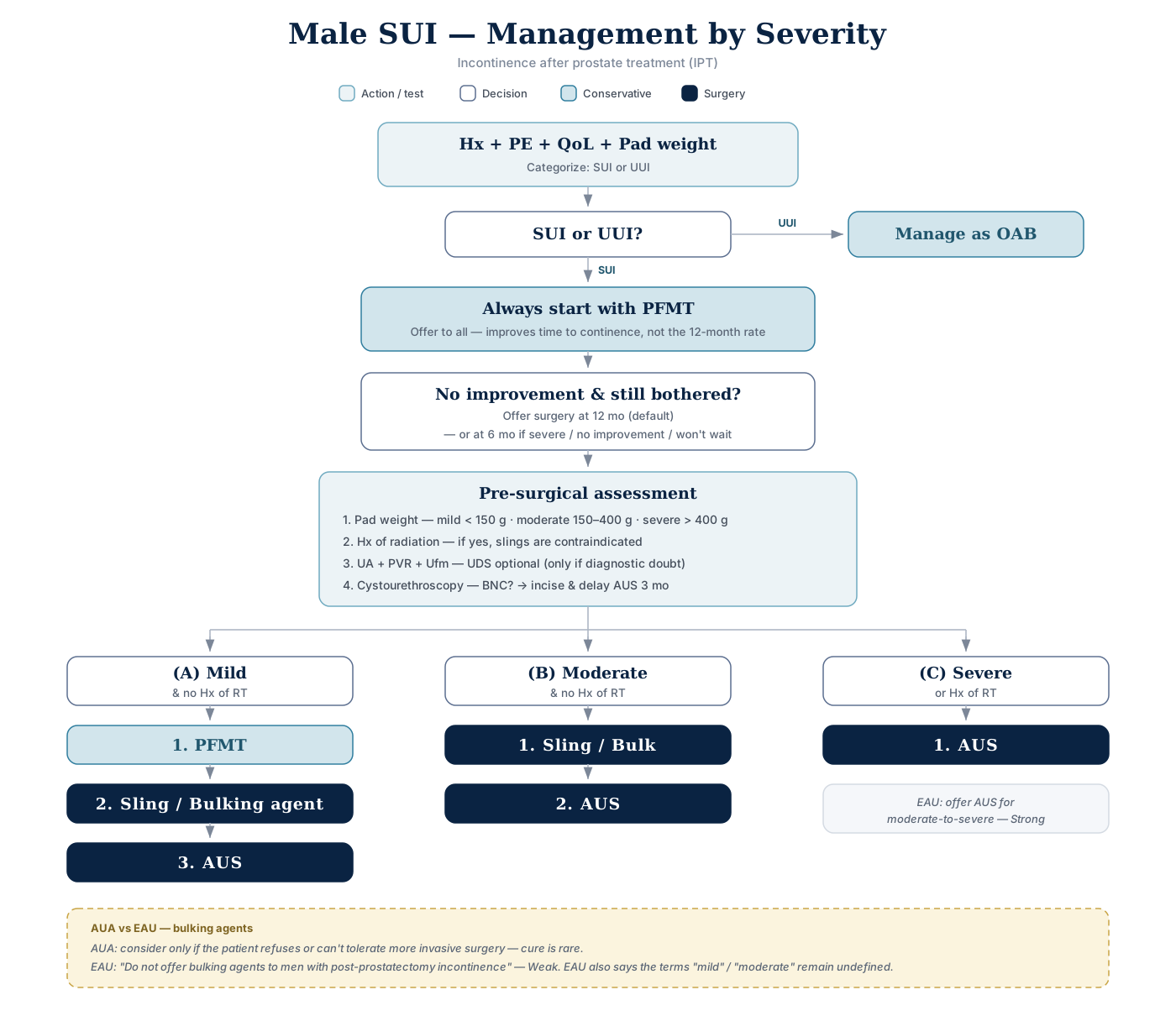
Click the algorithm to open it full size.
| (A) Mild & no Hx of RT | (B) Moderate & no Hx of RT | (C) Severe or Hx of RT | |
|---|---|---|---|
| 1 | PFMT | Sling / Bulk | AUS |
| 2 | Sling / Bulking agent | AUS | — |
| 3 | AUS | — | — |
Male Sling (Perineal Male Sling, PMS)
Features supporting a sling:
- Mild-to-moderate incontinence — 24-h pad test < 150 g mild, < 400 g moderate
- Adequate detrusor contractility — a sling is a fixed resistance and needs a bladder that can overcome it
- Poor dexterity or limited cognitive capacity — no pump to operate
- No prior radiation
- Patient preference against AUS infection/erosion risk
After a failed sling:
| Mode of failure | Management |
|---|---|
| Infection or erosion | Explant as much as possible; consider AUS 3–6 months later |
| Inadequate continence | Place an AUS (with or without sling explant), or replace the sling — replacement only by providers trained in it |
| Effect wanes over time (SUI recurs) | AUS, with or without incising the sling — results similar to a primary AUS |
- When placing an AUS after a failed sling, the sling may be left in place and the cuff sited 1.5–2 cm distal to it via a scrotal incision.
- Exam answer: after sling failure → AUS is preferred over:
- Urethral bulking agents — approved only for women (the severity table still lists bulking as a mild–moderate option)
- ProACT periurethral balloons — for mild–moderate SUI, but not used in sling failures
- Repeat sling — harder with one already in place and often no improvement (the table keeps replacement as an option for trained providers)
AUS — Components
- AMS 800 — three components: inflatable cuff, control pump, pressure-regulating balloon (PRB)
- Offer only in expert centers; warn of mechanical failure and explantation for infection or erosion in up to 24%
Composed of:
Cuff
- Location: bulbar urethra vs bladder neck
- In salvage → change position, transcorporal
- (A) Size: 4–4.5 cm standard.
- Available cuffs run 3.5 cm to 11 cm.
- Choose a cuff smaller than the measured circumference — a snug fit without constriction.
- In salvage, downsizing to 3.5 cm is an option, but the 3.5 cm cuff carries an increased erosion risk in previously irradiated patients.
- Irradiated + severe urethral atrophy → transcorporal cuff preferred over the smallest 3.5 cm cuff
- (B) Single cuff.
- In salvage, a second (tandem) cuff is described — but a single cuff placed more proximally is preferred:
- The tandem's apparent benefit is the proximal position rather than the second cuff, and it carries a higher explant rate (17% vs 4%).
- In salvage, a second (tandem) cuff is described — but a single cuff placed more proximally is preferred:
Pump
- In scrotum, deactivated 6 weeks post-op
- Left deactivated with the cuff deflated for an average of 4–6 weeks — longer if irradiated → a pseudocapsule forms around the cuff and erosion risk falls
PRB (reservoir)
- Placed retropubic
PRB fill volume ~20 mL · Pressure 61–70 cm H₂O (51–60 after radiation)
AUS — Indications, Contraindications, Technique
Indications
- Consider for mild to severe SUI · EAU: offer for moderate-to-severe — Strong
- Standard treatment for moderate-to-severe post-prostatectomy SUI persisting at 1 year despite failed conservative and medical management
- Preferred after (3):
- Radiation
- Urethral reconstruction (slings won't work after posterior/anterior urethral reconstruction)
- VUAS/bladder neck contracture (slings have decreased success)
Features supporting AUS:
- Moderate-to-severe incontinence (24-h pad test > 400 g = severe)
- Gravitational incontinence
- Failed sling or previous AUS
- Abnormal anatomy
- Prior radiation
- Adequate urethral tissue integrity · adequate bladder compliance · adequate cognition and dexterity
Beyond incontinence after prostate treatment, AUS is also used for:
- SUI after pelvic fracture urethral injury, spinal cord injury, or urethral reconstruction (the "stove-pipe" ISD urethra)
- Neurogenic bladder with sphincteric dysfunction
- Congenital disorders — myelomeningocele, sacral agenesis, the exstrophy/epispadias complex
- A last resort in women with ISD and a non-neurogenic bladder
Contraindications
| Absolute (6) | Relative (4) |
|---|---|
| Lack of physical/mental dexterity to work the pump | High-grade VUR |
| Repetitive UTIs | Recurrent bladder/urethral disease needing repeat transurethral instrumentation |
| Urethral diverticulum at implant site / poor urethral tissue integrity | Bladder neck contracture prior to treatment |
| Complex, unstable or recurrent urethral stricture | Detrusor overactivity |
| Small-capacity / non-compliant bladder before definitive treatment | |
| Active infection at the surgical site | |
| Detrusor–sphincter dyssynergia | Stones (require repeated urethral instrumentation) |
| High-pressure storage or contractions (> 40 cm H₂O) | Poor tissue quality — radiation contraindicates a sling; poor urethral integrity contraindicates AUS |
| Detrusor overactivity at low volumes | Immunosuppression |
| High-grade VUR at low intravesical pressure | Malignancy needing repeated urethral instrumentation |
Metastatic prostate cancer is not a contraindication to either AUS or a male sling.
Technique
- Single-cuff perineal approach preferred — superior to transverse scrotal incision
- Place the cuff as proximal on the bulbar urethra as possible, proximal to the convergence of the corporal bodies
- Incise skin → Colles fascia → bulbospongiosus muscle → Buck fascia where it reflects off the bulbar urethra onto the diverging corpora.
- Sharp dissection dorsally (blunt risks the thinner dorsal urethra); minimal electrocautery
- Commonest site of urethral perforation: the dorsal bulbar urethra, while mobilizing it off the corpora cavernosa (spongiosum thinnest here) → Metzenbaum scissors
- Create a 2-cm tunnel; the cuff gives a 2-cm zone of circumferential compression
- Remove any catheter >14 Fr before cuff sizing; cuff should fit snugly without constricting
- PRB approach: scrotal, perineal or abdominal.
- Contraindications to scrotal/perineal → mesh hernia repair, radical cystectomy/extensive abdominal surgery — use the abdominal approach to avoid bladder/bowel injury
- Verify coaptation by urethroscopy — closed cuff should cause slight blanching
- Urethral injury intra-op → repair with 4-0 absorbable, ABORT the procedure, delay implantation; catheter 7 days. The risk of device infection outweighs any benefit
- At reoperation after erosion or urethral injury → a transcorporal cuff lowers the risk of urethral injury (incisions go through the tunica albuginea, avoiding the spongiosum–cavernosum plane)
- Post-op: overnight stay, catheter out next morning, no drains; AUA says no antibiotics beyond 24 h peri-op (though many high-volume implanters give 1–2 weeks orally)
Bladder neck AUS
- For sphincteric UI where the prostate is undisrupted → myelomeningocele and other neuropathic disorders, children, exstrophy/epispadias. In these groups a bladder neck cuff should be considered before a bulbar cuff.
- Contraindicated after RP
- Advantages: lower likelihood of erosion and cuff atrophy
- Needs larger cuff (~8 cm), higher PRB (71–80), larger system volume. Robotic placement overcomes much of the technical difficulty
Post-AUS — Retention
- Early retention:
- Cause in the first days (catheter passes smoothly) → transient urethral edema from the periurethral dissection (the deactivated cuff exerts no coaptive pressure)
- First, confirm the cuff is deactivated.
- Insert a 10–12 Fr catheter for 24–48 h.
- If the patient fails a trial of void at 48 h → place an SPC (image-guided) to reduce the risk of erosion.
- Place under ultrasound or fluoroscopic guidance → avoids puncturing or contaminating the retropubic PRB
- Not prolonged urethral catheterization or CIC → both risk cuff erosion, even with the cuff deactivated
- Retention persisting for several weeks suggests an undersized cuff — correlate with the pre-operative urodynamics and consider cuff replacement.
- → may need reoperation with cuff upsizing
- Late-onset retention:
- Cystoscopy and urodynamics to rule out obstruction, erosion and detrusor failure.
- Symptomatic VUAS with a bulbar AUS
- → surgically uncouple the cuff, then treat endoscopically — balloon dilation or incision through a 21 Fr rigid cystoscope without uncoupling risks urethral erosion or cuff damage
Post-AUS — Recurrent/Persistent SUI
If a patient presents later with SUI:
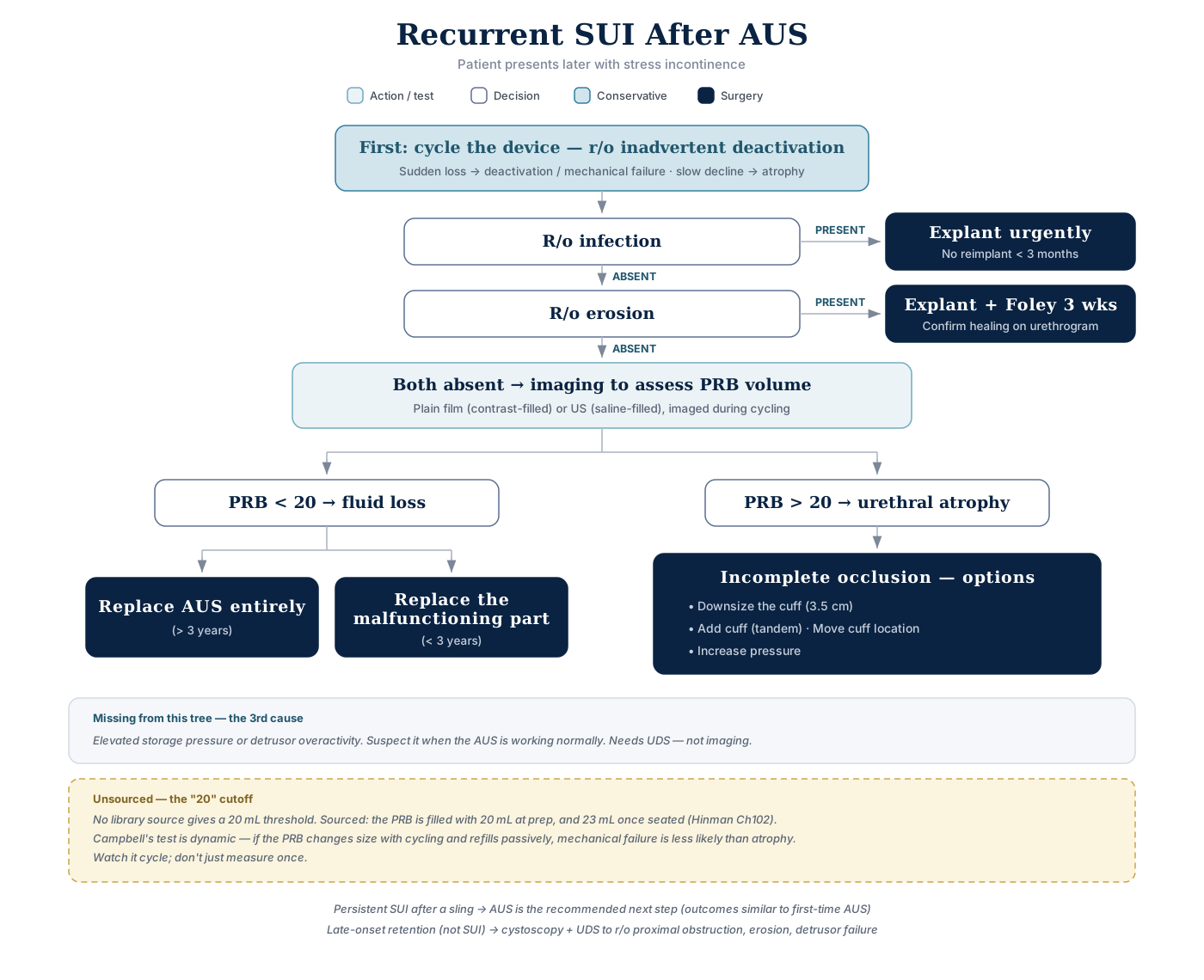
Click the algorithm to open it full size.
| Step | Finding | Action |
|---|---|---|
| 1 | Cycle the device | Rules out inadvertent deactivation before anything else |
| 2 | R/o infection | If present → explant urgently |
| 3 | R/o erosion | If present → explant + Foley for 3 wks |
| 4 | Both absent → imaging to assess PRB volume | ↓ |
| 4a | PRB < 20 — empty/underfilled = leak | Replace AUS (> 3 years) or replace the malfunctioning part (< 3 years). Exam answer: normal PRB = 23–24 mL; any lower volume = fluid loss → device failure → replace all components (cuff, pump, PRB), or only the leaking component if it failed < 2 years after placement |
| 4b | PRB > 20 — full PRB (~24 mL) = revise | Downsize the cuff · add cuff · move cuff location · increase pressure. Also tandem or transcorporal cuff. Filling the PRB beyond 23–24 mL is likely detrimental (raise the PRB pressure, not its volume) |
Onset points to the cause:
- Minor SUI of gradual onset, years after placement → urethral atrophy beneath the cuff
- Sudden loss of continence → device deactivation or mechanical failure
Erosion excluded — next test depends on cycling:
- Normal cycling (recurrent incontinence) → urodynamics next — exclude detrusor overactivity or ↓ bladder compliance before any surgical revision
- Urgency incontinence from detrusor overactivity despite mirabegron, working AUS → onabotulinumtoxinA via a small flexible cystoscope through the deactivated AUS
- Oxybutynin only with caution in older patients
- Urgency incontinence from detrusor overactivity despite mirabegron, working AUS → onabotulinumtoxinA via a small flexible cystoscope through the deactivated AUS
- No urethral coaptation on cycling (SUI, no infection) → image the PRB by ultrasound or cross-sectional imaging (step 4)
AUS Complications
Beyond the device-specific problems below, AUS surgery carries the general risks of bleeding/hematoma and injury to adjacent organs.
| Complication | Numbers | Management |
|---|---|---|
| Infection | 1–3%, up to 10% in high-risk/radiated (AUA gives < 1–5%). S. epidermidis (most common) + S. aureus | Urgent explantation — implant infections are not amenable to antibiotics. No reimplantation for ≥ 3 months. Late infections (> 4 months) suggest indolent organisms or hematogenous spread rather than implantation contamination |
| Cuff erosion | Up to 5% of implants. Presents with pain, infection, hematuria or urethral bleeding — not isolated minor gradual SUI. High-risk group: pelvic radiation, prior urethroplasty, repeated stricture or bladder neck procedures, a urethral stent, prior erosion or infection. Smaller added risk: catheterization > 48 h, a 3.5 cm (vs standard 4 cm) or transcorporal cuff. No added risk: age, prior radical prostatectomy, proximal vs distal bulbar cuff site. Prior erosion = fragile urethra → 5-yr re-erosion approaching 50% | Explant (all components — assumed infected) + catheter a few weeks. No reimplantation < 3 months, and confirm urethral healing by urethrography. Pelvic radiation is the most important risk factor for cuff erosion. Approximate the perineal wound loosely, healing by secondary intention. Site the new cuff proximal or distal to the previous position, and consider nightly deactivation after re-implantation for a prior erosion. A transcorporal cuff is described here, though it is itself associated with higher erosion rates — largely because it is chosen for higher-risk urethras. Redo AUS after erosion, once the repair has healed (a normal urethroscopy also confirms it) → transcorporal cuff: a layer of tunica albuginea backs and bulks the thin dorsal urethra against re-erosion; expect more transient retention needing suprapubic drainage after transcorporal placement |
| Urethral atrophy | Due to chronic compression of the spongy tissue. Most common cause of gradual return of incontinence + AUS revision. Accounts for 7.9% of AUS complications; radiation is independently linked. Workup: low abdominal leak point pressure (ALPP), no detrusor overactivity, atrophic urethra under the cuff on cystoscopy | Downsize cuff · move cuff proximal/distal to thicker urethra · tandem cuff · transcorporal cuff — pick among these by intraoperative findings; downsize in the same location when possible. Don't just switch to a higher-pressure reservoir → raises erosion risk. Best prevention: nocturnal deactivation — removes several hours of ischemic compression nightly without costing continence |
| Mechanical failure | 7–10-yr device life; failure ≈ 24% at 5 yrs, ≈ 50% at 10 yrs. Revision 16% at 2 yrs, 28% at 5 yrs — all | Micro-perforation of any of the 3 parts/tubing/connections → fluid loss. The cuff is the commonest site of leak. Within 3 years and with no infection or erosion, replacing only the malfunctioning component is reasonable; devices older than 3 years should be replaced in toto |